
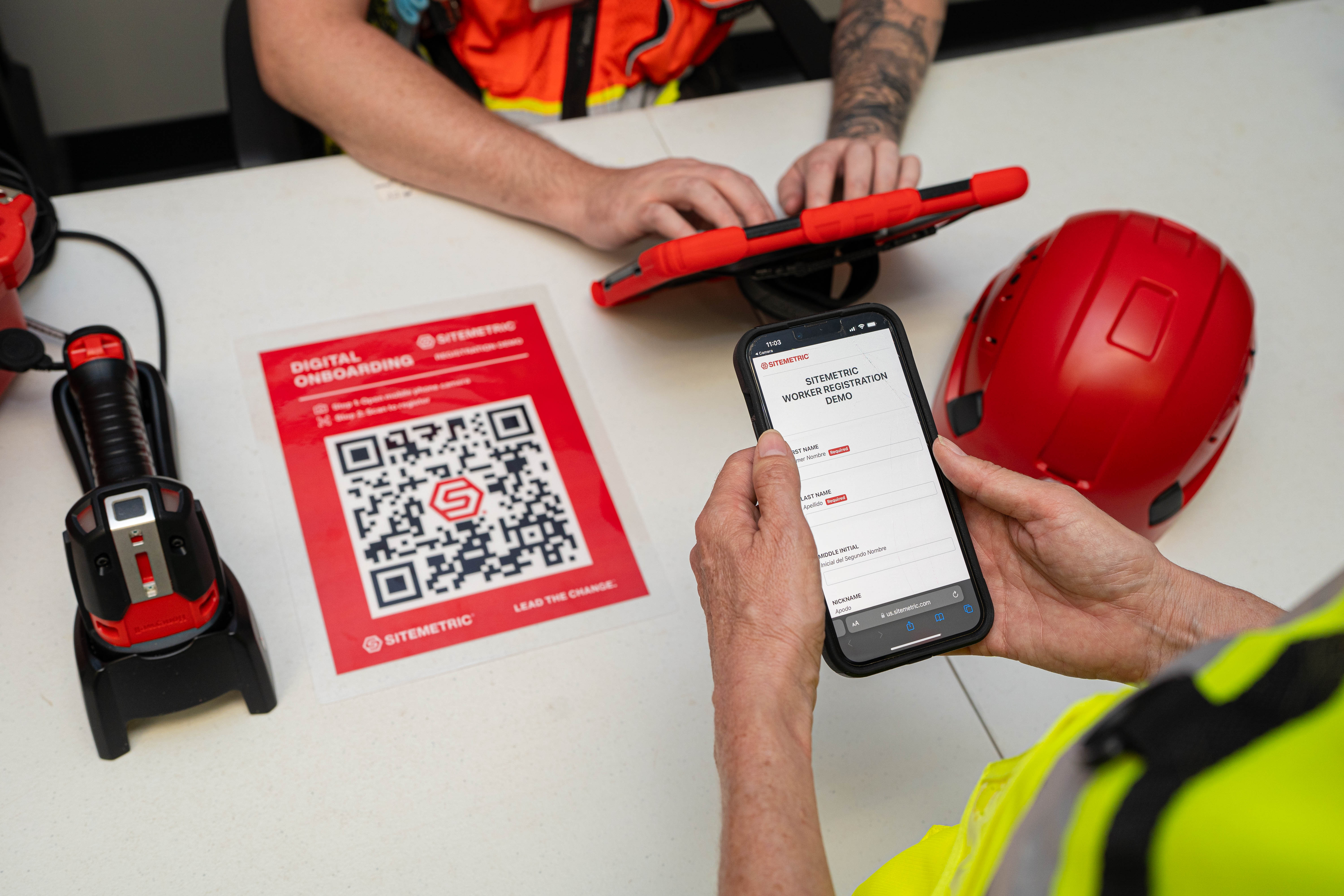
Construction worker onboarding is the process of collecting a worker's information, delivering site-specific orientation and safety training, verifying required credentials, and granting jobsite access. Done digitally and before arrival, it turns the first morning from an hour in a trailer into a fast badge scan at the gate.
Construction worker onboarding is everything that happens between a worker being assigned to a project and that worker being cleared to work on it. It covers registration, site orientation, safety training, credential verification, and badge issuance.
The terms “registration” and “orientation” overlap in practice. Registration is data collection: name, employer, trade, contact details. Orientation is delivery: site rules, hazards, emergency procedures, and project-specific requirements. Onboarding is usually used to mean the whole sequence.
The distinction matters when scoping a system, because products differ in which parts of onboarding they handle. A badging system that registers workers does not necessarily deliver orientation, and an orientation platform does not necessarily produce a credential.
1. Registration. The worker provides their information, either through a link before arriving or at a station onsite. Pre-registration moves the data entry to the worker and off gate staff, which is the single largest lever on gate throughput.
2. Document and credential collection. OSHA training cards, trade certifications, licenses, and any project-specific documentation. Collecting these during onboarding rather than at the gate is what prevents a worker arriving unqualified and being turned away.
3. Site orientation. The rules, hazards, emergency procedures, muster points, and site-specific requirements for this project. Increasingly delivered as video with a comprehension check rather than a room and a slideshow.
4. Verification. Someone or something confirms the documentation is valid and current. This is the step that separates a real onboarding program from a filing exercise.
5. Badge issuance. The worker receives a credential linked to their record, which is what turns onboarding into access.
6. Access activation. The credential is added to the access list for the areas and shifts the worker is cleared for.

The same five steps cost very different amounts of schedule depending on where they run.
Fully onsite. The worker arrives, queues, fills in a form, watches orientation, waits for verification, and receives a badge. On a large project at mobilization this produces a line at 6am that consumes the first hours of the day for everyone in it.
Pre-registration with onsite completion. The worker submits information and documents in advance, then completes orientation and receives a badge on arrival. This is the common middle ground and it removes most of the queue.
Fully pre-cleared. Registration, documents, verification, and orientation all complete before the worker arrives. The first morning is a badge collection and a gate scan.
Ramp-up is where the difference shows. A project adding two hundred workers in a week experiences its onboarding process very differently from one adding five.
Orientation is the part most often treated as a formality and most often cited after an incident.
Content is project-specific. Site layout, access points, muster locations, active hazards, restricted areas, and the rules this project enforces. A generic construction safety video fails to orient to the specifics of the jobsite.
Delivery format affects retention and throughput. Video with a comprehension quiz produces a record of who watched and who understood, and it scales to a crew arriving at once. A supervisor delivering orientation in person does not scale and is difficult to document.
Language matters on a multilingual workforce. Orientation delivered in a language a worker does not read may be a compliance record but is not training.
Re-orientation is a real requirement. Phase changes, new hazards, and workers returning after months away all warrant re-orientation, and most programs have no mechanism for delivering it.
Onboarding is where the workforce record begins. Everything downstream depends on it being complete.
The credential issued at onboarding is what access control checks at the gate. The certifications collected during onboarding are monitored by expiration alerting. The employer and trade captured at registration feed into headcount and hours reports. A gap in onboarding data becomes a gap in every report that follows.
Onboarding that lives in a separate system from access control creates recurring work. When a worker's certification is updated in the onboarding platform, the access system needs to know, and if the two are not connected then someone must update both by hand or else the gate enforces stale information.
Sitemetric handles registration, orientation, credential verification, and badge issuance as one sequence, with Access Control Officers typically running the process onsite so it does not land on the project team.
Onboarding is the whole sequence: registration, document collection, orientation, verification, and badge issuance. Orientation is one step of that sequence, specifically the delivery of site rules, hazards, emergency procedures, and project requirements. Systems differ in which parts they handle, so it is worth asking rather than assuming a product covers both.
The measure worth tracking is time from arrival to productive work, not time to complete a form. When registration, documents, and orientation are completed before a worker arrives, the first morning is simply a badge collection and a gate scan. Where everything happens onsite, a large crew arriving at once can lose most of a morning.
Yes, and on projects with fast ramp-up it can be the difference between a queue and a quick gate scan. Sitemetric supports digital registration offsite, credential collection in advance, and pre-clearing workers before their first day, so arrival is a badge collection rather than an enrollment session.
No, and in-person delivery can be difficult to scale and to document. Video with a comprehension quiz produces a record of both completion and understanding, handles a crew arriving at once, and can be delivered in more than one language. In-person orientation still has a place for site walks and phase-specific briefings.
Typically, worker identity and employer information, trade, OSHA training, trade certifications and licenses, and whatever the project specifically requires. Collecting these during onboarding rather than at the gate prevents a worker arriving unqualified, and it gives credential expiration alerting something to monitor.
They should not have to. A Sitemetric badge can work across every jobsite and project on the account, so a worker moving between your jobs carries their record and credentials with them. Where onboarding is project-scoped, the same worker is enrolled repeatedly and the administrative cost recurs on every job.
Sitemetric integrates with existing onboarding processes and platforms rather than requiring the whole process to move. This matters most on projects where an owner or a general contractor already mandates a specific onboarding tool, since replacing it is usually not an option.
The platform tracks expiration dates captured at registration and issues alerts before a credential lapses. When onboarding and access control are separate systems, an expired certification in one does not reach the other, so the gate can continue admitting a worker whose qualification ended.
Talk with our team about your jobsite needs and learn how Sitemetric can help your project succeed.

