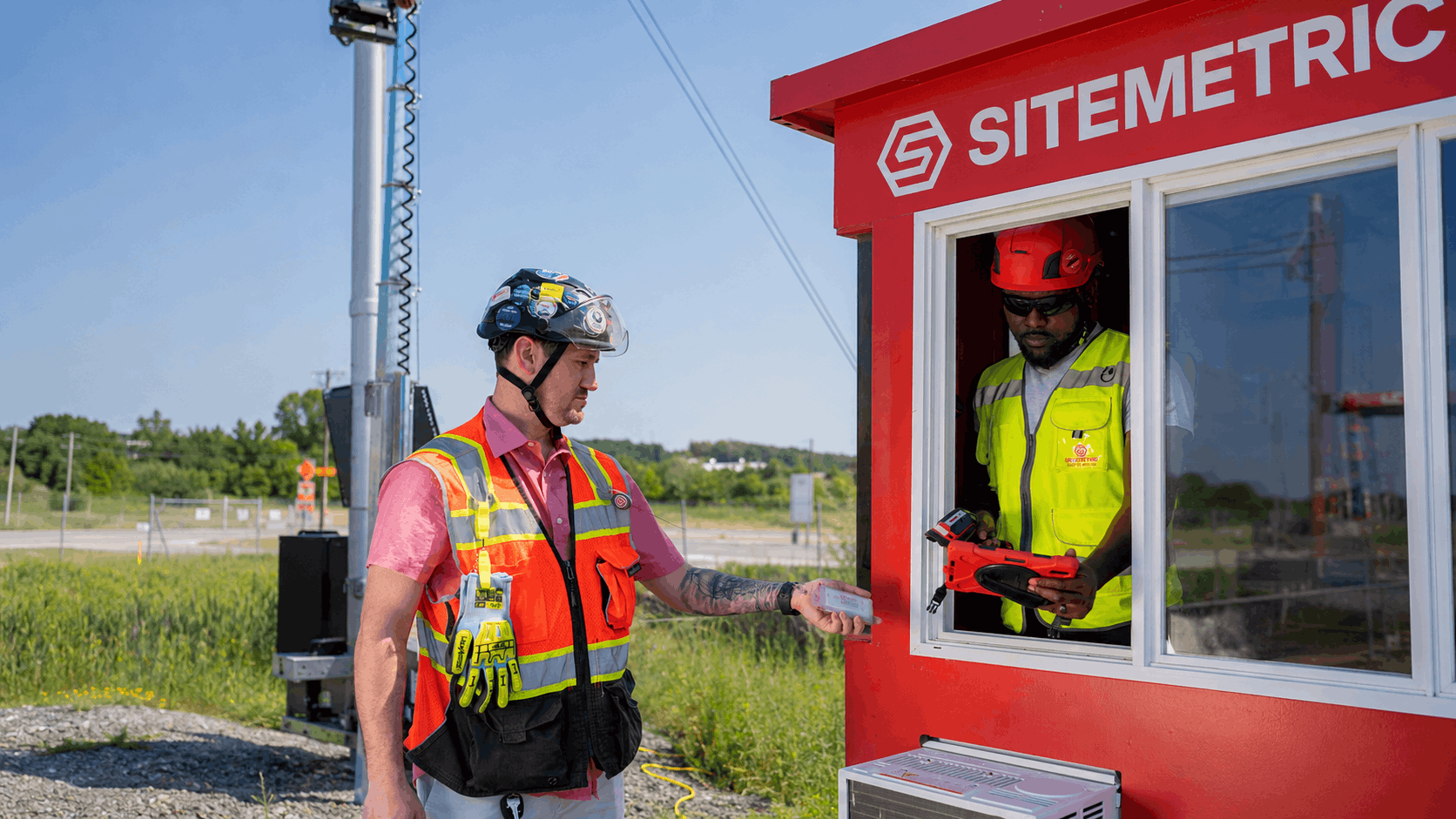
Access Control Officer scanning a worker badge at a construction site access control booth

Construction Site Access Control: What It Is and How It Works

Construction site access control is the physical and digital system that determines who can enter a jobsite and which areas they can reach. It combines infrastructure such as turnstiles and staffed entry points with a digital access list, and it records every entry, exit, and denial as it happens.

Key takeaways

  • Access control is the enforcement layer. Badging is the credentialing layer. Most projects deploy both together.
  • Gate layouts change as a project phases, so entry points generally have to move with them.
  • Gate throughput usually determines whether the system works in practice, since the morning queue is what the trade stack actually experiences.
  • Connectivity is the most commonly overlooked requirement, since many jobsites start with no network and no permanent power.
  • The records access control produces are increasingly what owners and insurers ask for.

What is construction site access control?

Construction site access control is the practice of controlling and documenting entry to a jobsite. Every person who arrives is checked against a list of who is authorized to be there, and the system either permits or denies entry and records what happened either way.

Access control has a physical layer and a digital one. Physically it covers the turnstiles, staffed entry points, gate arms, and perimeter that channel people through controlled points rather than wherever the fence has a gap. Digitally it covers the access list, the credential check, and the permissions that decide which areas a given worker can reach.

Access control and badging are related but distinct. Badging is the credentialing layer: registering workers, verifying qualifications, and issuing an ID. Access control is the enforcement layer that reads that ID and acts on it. A badging program without enforcement produces a roster. Enforcement without badging leaves gate staff with nothing to check a worker against.

Several terms describe the same practice: site access control, gate control, controlled site access, and jobsite access management.

How does construction site access control work?

1. Define the access list. The project establishes who is authorized: which companies, which workers, which trades, and what each has to have completed to qualify. Orientation, trade certifications, and site-specific training are common conditions.

2. Channel people through controlled entry points. A jobsite with an open perimeter has no access control regardless of what software is running. Entry points go where people and vehicles actually arrive, and the perimeter directs everyone else toward them.

3. Verify the credential. At the entry point the worker presents a badge to a turnstile, reader, or staffed checkpoint. The system checks it against the current access list.

4. Grant or deny, and record either way. A denial carries as much information as an approval. Denied access events are what surface expired certifications, revoked credentials, and people attempting to enter a jobsite they are not cleared for.

5. Control internal zones. On larger projects, entering the jobsite is not the same as being cleared for every part of it. Restricted areas, high-risk work zones, and owner-controlled spaces often need their own permissions.

6. Produce the record. Every scan builds the entry and exit history that becomes daily headcount, hours by company, gate traffic, and the compliance documentation an owner or insurer asks for.

Components of a construction access control system

  • Full-height turnstile
    • What it does: physical barrier that permits one credentialed person at a time
    • Best suited to: primary worker entrances and high-volume gates
  • Badge reader or scanner
    • What it does: reads the credential and checks it against the access list
    • Best suited to: any entry point, including temporary ones
  • Staffed entry point
    • What it does: a person verifies credentials, documents visitors and deliveries, and handles exceptions
    • Best suited to: main gates and jobsites with heavy visitor or delivery traffic
  • Access control booth
    • What it does: enclosed workspace at the gate for credential verification and site operations
    • Best suited to: projects needing a permanent staffed presence at the entrance
  • Gate arm
    • What it does: controls vehicle entry
    • Best suited to: vehicle gates, delivery lanes, and parking
  • Zone controls
    • What it does: permissions for specific areas inside the jobsite
    • Best suited to: restricted or high-risk areas on large projects
  • Cameras
    • What it does: visual record at entry points and along the perimeter
    • Best suited to: after-hours coverage, incident review, and unbadged entry detection

__wf_reserved_inherit

Why access control matters on construction projects

  • Owner and insurer requirements. On mission-critical projects such as data centers, healthcare, government, and semiconductor fabs, controlled credentialed access is often written into the contract rather than offered as an upgrade. Owners want documented proof that only authorized people entered.
  • Knowing who is onsite. During an evacuation, an accurate count is what separates an orderly muster from a search. Access control is what produces that count.
  • Keeping unauthorized people out. Construction sites hold high-value equipment and materials in an environment that is open by nature. A controlled perimeter with defined entry points is the first layer of site security.
  • Subcontractor accountability. Access records show which companies were onsite, on which days, at what headcount and for how many hours. Manpower claims become checkable against a record.
  • Protecting the schedule. Gate throughput usually decides whether crews accept the system. Ten extra minutes per worker on a 1,000-person jobsite creates a productivity problem larger than the one access control solves.

What to look for in a construction access control system

  • Throughput per entry point. Ask for people per minute, then multiply by peak crew size to see how long the morning queue runs.
  • What happens when connectivity drops. Ask whether the gate stops working or keeps making access decisions and syncs later. On a remote jobsite this separates a functioning entrance from a manual one.
  • What happens during a power loss. Ask about battery backup, and ask what state the entry point fails to. Fail-secure on entry with fail-safe on exit maintains site integrity without trapping anyone.
  • How hard it is to move an entry point. Gate layouts change through the project. Anchor bolts, concrete pads, and permanent electrical turn relocation into a construction task. Ask what adding or moving a lane involves.
  • Whether one credential covers everything. Separate credentials for turnstiles, doors, and zones create administrative work that grows with the project.
  • How denials are handled. Someone has to resolve the worker whose certification expired overnight. Ask whether that is your team or the vendor.
  • What records come out of it. Ask to see an actual access report rather than a description of one.
  • Certifications on the hardware. UL and CAN/ULC listings matter for access control equipment, particularly on projects where the owner runs a formal security review.

How Sitemetric approaches construction site access control

Sitemetric combines access control hardware, software, and onsite personnel in one system rather than three vendors. Badging establishes the credential, turnstiles and staffed entry points enforce it, and every event feeds the same reporting layer. More than 1.5 million workers across 40 states are on the Sitemetric platform, including 90% of the top 20 ENR contractors.

  • Entry points that move with the project. Turnstiles mount on a forklift-ready diamond plate base and need no anchor bolts, concrete pad, or electrician. Add a lane at a busy gate or relocate an entrance as jobsite phases change.
  • Throughput of 15 to 30 people per minute per direction. Full-height 94.5 inch three-rotor design, sized for shift change rather than office traffic.
  • Access decisions made on the device. Entry keeps working and events keep logging when connectivity drops. 4G LTE with automatic fallback via dual SIM means no site IT infrastructure is required.
  • Two hours of battery backup. An integrated UPS carries up to 2,000 rotations during a power loss with automatic switchover, keeping the entry point locked and monitored. Fire alarm auto-unlock maintains safe egress.
  • Access Control Officers at the gate. Sitemetric personnel verify credentials, document visitors and deliveries, badge workers, and resolve the exceptions software alone cannot.
  • A record you can hand to an owner. Site Access, Denied Access, Gate Traffic, Headcount and Hours, and the Daily Report, all produced from the same entry and exit events. See Sitemetric reporting.
  • Certified equipment. UL 294:2018 Listed, CAN/ULC S319 Certified, FCC Part 15 compliant, and manufactured in the USA.
Explore Sitemetric Access Control

FAQs

Badging is credentialing: registering workers, verifying their qualifications, and issuing an ID. Access control is enforcement: the turnstiles, readers, and staffed entry points that check that ID and permit or deny entry. Badging decides who should be allowed in. Access control makes it true at the gate.

It depends on peak headcount and how the jobsite is laid out rather than on square footage. Work backward from your busiest shift change: divide peak crew size by the throughput of one entry point to see how long the queue runs. Most projects also separate worker entry from vehicle and delivery access.

It should, and this is worth asking about specifically. Sitemetric turnstiles make access decisions on the device rather than in the cloud, so entry keeps working and events keep logging when connectivity drops. They include 4G LTE cellular with automatic fallback, and an integrated UPS provides up to two hours or 2,000 rotations during a power loss.

Through zone permissions. Being cleared to enter the jobsite is not the same as being cleared for every part of it. Restricted areas, high-risk work zones, and owner-controlled spaces can each carry their own access rules, so a worker credential opens the areas that worker is qualified for.

On most projects it will, more than once. Sitemetric turnstiles relocate by forklift with no anchor bolts or permanent infrastructure, and connect to the same access list wherever they are placed. Ask any vendor what relocating an entry point actually involves before the first one is installed.

Hardware handles the routine case, which is a credentialed worker arriving for their shift. People handle everything else: visitors, deliveries, a worker whose certification lapsed overnight, a subcontractor who arrived without being registered. Most projects run both, with Access Control Officers managing exceptions and documenting visitor and delivery traffic.

Every entry, exit, and denial is timestamped. That produces Site Access and Denied Access records, Gate Traffic covering entry and exit scans, Headcount and Hours by company, and a Daily Report showing headcount across the life of the project. These are the records owners and insurers increasingly ask for.

Sitemetric integrates with Procore, Autodesk, and other project management platforms, and offers API and Single Sign-On integration. Sitemetric turnstiles arrive ready to deploy with no field wiring, and include a dry contact interface for integration with existing access control systems.

The job moves fast.
Your tech should too.

Talk with our team about your jobsite needs and learn how Sitemetric can help your project succeed.