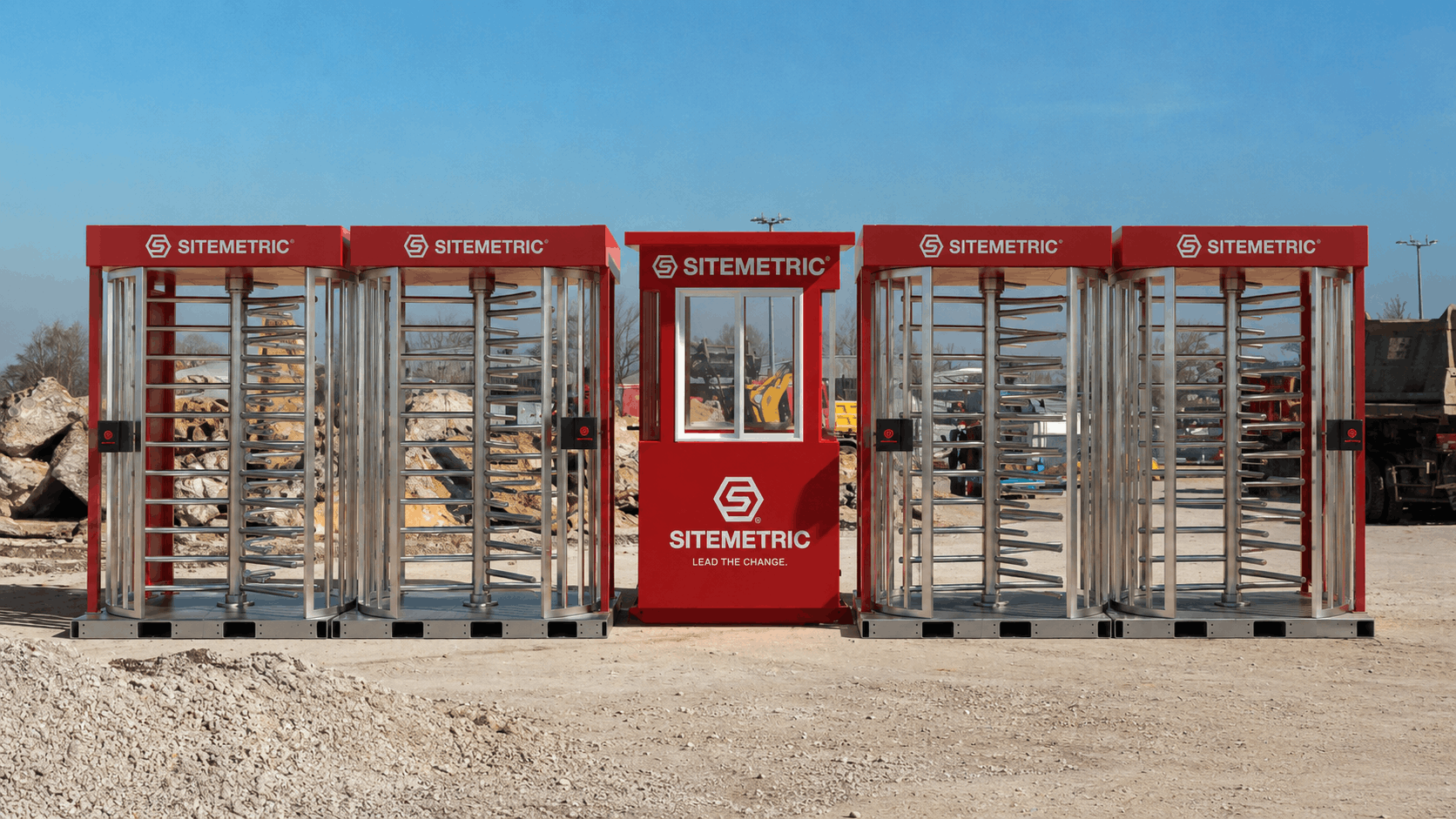
Full-height Sitemetric turnstile controlling worker entry at a construction site gate

Construction Turnstiles and Badge Readers: A Practical Guide

Construction turnstiles are physical entry barriers that admit one credentialed worker at a time, and badge readers are the devices that verify the credential before the barrier releases. Together they turn a gate into a controlled entry point that records every entry and exit rather than relying on a sign-in sheet.

Key takeaways

  • Throughput per lane is the number that determines how many turnstiles a jobsite needs, and everything else follows from peak headcount.
  • Full-height turnstiles are the construction standard because they cannot be climbed over or crawled under.
  • Power and connectivity are where most construction deployments get complicated, so ask what happens when either one fails.
  • Deployment method matters as much as the unit, since anchor bolts and concrete pads turn every relocation into a construction task on a jobsite whose gates move.
  • A full-height turnstile is not an accessible route, so projects generally need an alternate accessible entry alongside it.

What are construction site turnstiles?

A turnstile is a physical barrier that permits one person to pass at a time, releasing only when a valid credential is presented. On a jobsite it converts an open gate into a controlled entry point, so the access list is enforced physically rather than by observation.

Turnstiles and readers do different jobs. The reader verifies identity and makes the decision. The turnstile enforces it. A reader on its own records who scanned but cannot stop anyone walking past. A turnstile without a reader is a gate with extra steps.

Turnstiles sit inside a broader access control program. They enforce the credentials that badging creates, and they generate the entry and exit events that produce headcount, hours, and gate traffic records.

Types of construction turnstiles

  • Full-height
    • How it works: floor-to-ceiling rotor, typically three-arm, that cannot be bypassed over or under
    • Where it fits: the construction standard, used at primary worker entrances and any gate needing real physical security
  • Waist-high tripod
    • How it works: three rotating arms at waist height
    • Where it fits: lower security, suited to interior or supervised entrances where the barrier is a deterrent rather than a control
  • Optical or speed gate
    • How it works: sensors detect passage, with glass or no barrier
    • Where it fits: uncommon on construction, since it is built for clean indoor lobbies rather than weather and dust
  • Swing or accessible gate
    • How it works: powered or manual gate wide enough for equipment and accessible entry
    • Where it fits: alongside full-height units for accessible entry, deliveries, and material movement

Badge readers and credential technologies

Readers differ in how they read a credential and how close it has to be. Most construction badges carry more than one technology so a single credential works across different equipment.
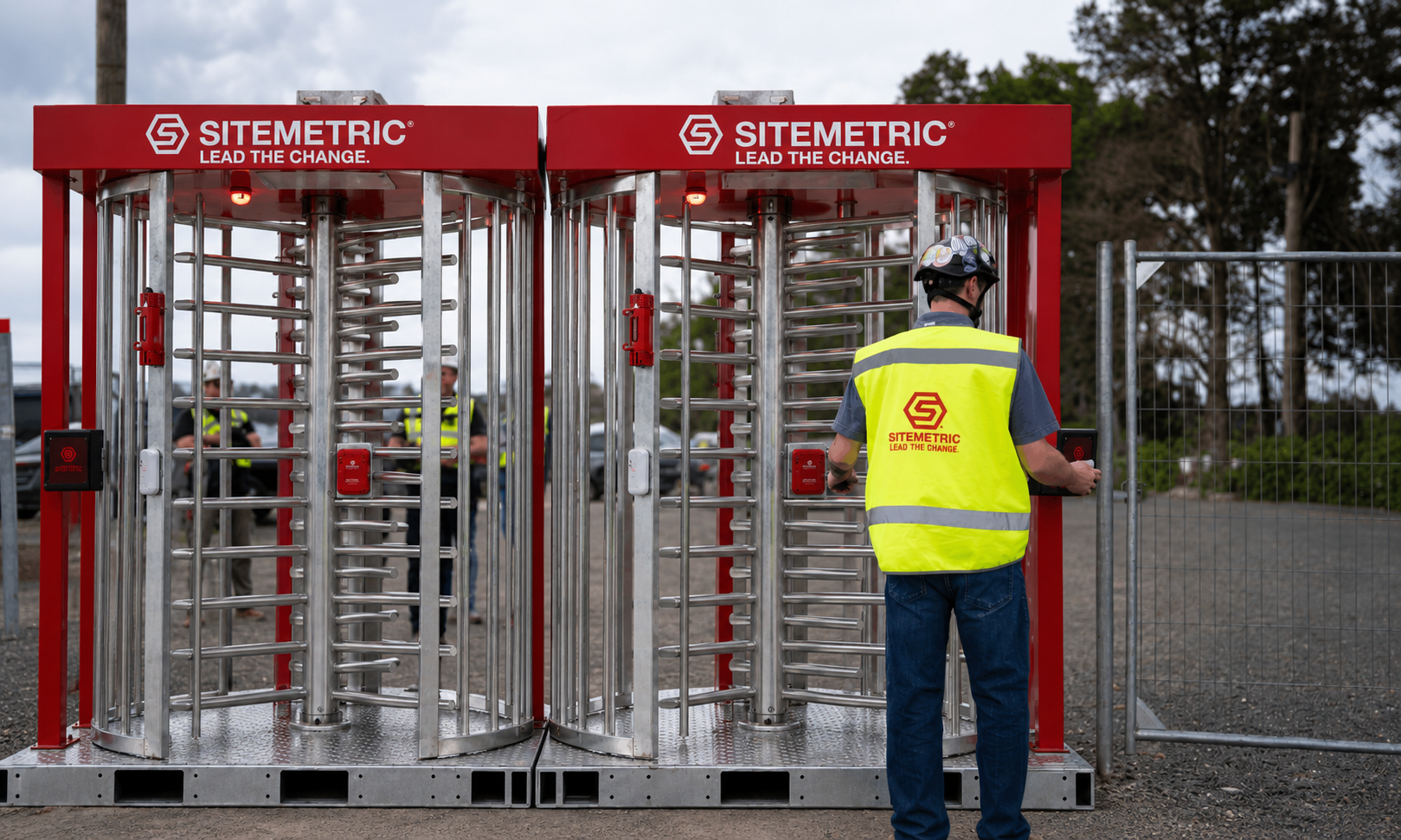
  • Barcode and QR scanner
    • Reads: 1D and 2D barcodes, optically
    • Practical notes: simplest to deploy and works with printed badges, though it needs line of sight and a reasonably clean badge surface
  • NFC
    • Reads: contactless tap, ISO 14443 and ISO 18092
    • Practical notes: fast and reliable in the field, and supports mobile credentials as well as cards
  • RFID
    • Reads: contactless at longer range than NFC
    • Practical notes: useful where hands-free or higher-speed entry matters
  • BLE
    • Reads: Bluetooth Low Energy
    • Practical notes: used for zone-level detection and safety functions more than gate entry
  • Biometric
    • Reads: fingerprint, facial, or iris
    • Practical notes: available in the wider market, though privacy, consent, and state-law considerations lead most construction projects to avoid it

__wf_reserved_inherit

Turnstile specifications that matter

Throughput

Throughput is people per minute per direction, and it determines how many lanes a jobsite needs. Work backward from peak headcount. A 600-person crew at a single lane running 20 people per minute takes 30 minutes to clear, and that half hour repeats every morning for the life of the project.

Power

Turnstile power requirements come down to three things: the voltage and circuit the unit needs, what it draws in operation versus standby, and what happens when power is lost. Battery backup determines whether an outage leaves a locked, monitored entrance or an open gate.

Connectivity

Many jobsites begin with no network at all. Where the access decision is made separates products. If it happens in the cloud, a dropped connection stops the gate. If it happens on the device, entry continues and events sync when the connection returns.

Weather and environment

An IP rating describes resistance to dust and water. Construction turnstiles live outdoors in weather that indoor equipment is not built for, and galvanized steel construction matters for the same reason.

Certifications

UL 294 is the standard for access control system units, and CAN/ULC S319 is its Canadian counterpart. On projects where the owner runs a formal security review, listed equipment is often a requirement rather than a preference.

Deployment method

Deployment method is the specification most often overlooked and most often regretted. A unit requiring anchor bolts, a concrete pad, and an electrician is effectively permanent. On a jobsite where gate layouts change through the phases, that turns every relocation into a project.

Siting and deployment on an active jobsite

  • Place lanes where people actually arrive. Entry points follow parking, transit, and the trailer complex, not the site plan drawn at mobilization.
  • Separate people from vehicles. Worker entry and delivery or vehicle access work better in separate lanes, since they have different flow rates, different verification, and different risk.
  • Plan for the peak, not the average. Shift change is the constraint. Headcount at 7am is what sizes the entrance.
  • Expect the gate to move. Excavation, structure, and fit-out rarely share an entrance, so assume at least one relocation.
  • Provide an accessible alternate entry that reads the same credential and records the same event, so the record stays complete and the jobsite stays compliant.
  • Decide who resolves exceptions. A worker with an expired certification at 6:45am is a person problem rather than a hardware one. On Sitemetric jobsites, Access Control Officers at the entry point handle these cases, along with visitor and delivery verification, so a queue does not form behind one unresolved credential.

What to look for when specifying turnstiles and badge readers

  • People per minute per direction, and how many lanes that means for your peak crew
  • What happens when connectivity drops. On-device decisioning or a stopped gate?
  • Battery backup runtime, and what state the unit fails to. Fail-secure on entry with fail-safe on exit keeps the jobsite controlled without trapping anyone.
  • Whether fire alarm integration auto-unlocks for egress
  • IP rating and construction material
  • UL 294 and CAN/ULC listing
  • What relocation involves: anchor bolts, pad, electrician, or a forklift
  • Whether the reader and controller arrive integrated or need field wiring
  • Anti-passback support, so a credential cannot be handed back through the fence
  • Whether firmware updates require a site visit
  • Lead time from order to operational

How Sitemetric approaches construction turnstiles and badge readers

The Sitemetric Deluxe Turnstile is a full-height access control system built for active jobsites, with the reader and controller factory-integrated so there is no field wiring at installation. It reads the same Sitemetric badge used everywhere else on the project. More than 1.5 million workers across 40 states are on the Sitemetric platform, including 90% of the top 20 ENR contractors.

Specifications

  • Height. 94.5 inches, three-rotor full-height barrier.
  • Footprint. 60 inches wide by 54 inches deep, 48 inch rotor diameter.
  • Passage width. 25-15/32 inches.
  • Throughput. 15 to 30 persons per minute per direction.
  • Weight. Approximately 1,400 lbs assembled.
  • Construction. 18-gauge galvanized steel, IP56, under 55 dB.
  • Power. 110 VAC 50/60 Hz, one 15A circuit per group of up to three units. 60 W mechanism, under 150 W total, under 15 W standby.
  • Battery backup. Integrated UPS, up to 2 hours or 2,000 rotations, automatic switchover.
  • Connectivity. 4G LTE Cat 6 with automatic 3G fallback via dual SIM, Wi-Fi 802.11ac, NFC (ISO 14443 / ISO 18092).
  • Integration. Dry contact interface compatible with 12/24VDC access control systems.
  • Certifications. UL 294:2018 Listed, CAN/ULC S319 Certified, FCC Part 15 Compliant, Manufactured in the USA, 12-month warranty.

Features

  • Deploys by forklift. The diamond plate base lifts and relocates in minutes. No anchor bolts, no concrete pad, no electrician, no permanent infrastructure.
  • Keeps working when the network drops. Access decisions are made on the device rather than in the cloud, so the unit continues operating and logging through connectivity loss.
  • Keeps working when the power drops. The integrated UPS switches over automatically and holds the entrance locked and monitored. Fire alarm integration auto-unlocks for egress, so entry stays secure and exit stays safe across every power scenario.
  • Configures itself. Zero-touch provisioning connects the unit to the Sitemetric cloud on first power-up and downloads the full access list. No technician, no IT setup. Firmware updates arrive over the air with no site visit.
  • Enforces credential integrity. Anti-passback controls prevent a credential from being used to enter twice in a row without a valid exit. Remote emergency unlock is available to administrators from the mobile app.
  • Feeds the record. Every entry and exit is timestamped and synced, producing Gate Traffic, Site Access, Denied Access, and Headcount and Hours reports. See Sitemetric reporting.
Explore Sitemetric Access Control

FAQs

Divide peak crew size by throughput per lane. A Sitemetric turnstile handles 15 to 30 people per minute per direction, so a 600-person jobsite at 20 per minute clears in about 30 minutes through a single lane. Most projects add lanes to bring shift change under 15 minutes, and separate worker entry from vehicle and delivery access entirely. Talk with the Sitemetric team for turnstile deployment advice tailored to your jobsite.

Not all of them. Sitemetric turnstiles mount on a forklift-ready diamond plate base and require no anchor bolts, concrete pad, or permanent infrastructure. This matters more than it sounds, because gate layouts change as a project moves through excavation, structure, and fit-out, and a permanently mounted unit turns each of those changes into a construction task.

On a Sitemetric turnstile, both scenarios are covered. An integrated UPS provides up to two hours or 2,000 rotations with automatic switchover, keeping the unit locked and monitored. Access decisions are made on the device rather than in the cloud, so entry continues and events keep logging through a connectivity loss and sync when the connection returns.

It depends on the credential. Sitemetric turnstiles include NFC reader support to ISO 14443 and ISO 18092, which covers both card and mobile credentials. Badges printed on the Sitemetric Onsite ID Printing Station also carry barcode and QR encoding for turnstile and reader access with no separate encoder step.

A full-height turnstile is not an accessible route. Projects using them generally need an alternate accessible entry alongside, ideally one that reads the same credential and records the same access event so the entry record stays complete. Plan the accessible entry at the same time as the turnstile lanes rather than after.

UL 294 is the standard for access control system units, with CAN/ULC S319 as the Canadian equivalent. Sitemetric turnstiles are UL 294:2018 Listed, CAN/ULC S319 Certified, FCC Part 15 compliant, and manufactured in the USA. On projects where the owner runs a formal security review, listed equipment is often required rather than preferred.

Anti-passback controls prevent a credential from being used to enter an area twice in a row without a valid exit, so a badge cannot be passed back through the fence. Duplicate scan activity is separately reported so repeat patterns can be reviewed.

Sitemetric turnstiles arrive ready to deploy with no field wiring, and include a dry contact interface compatible with 12/24VDC access control systems for integration with equipment already onsite.

The job moves fast.
Your tech should too.

Talk with our team about your jobsite needs and learn how Sitemetric can help your project succeed.