
.jpg)
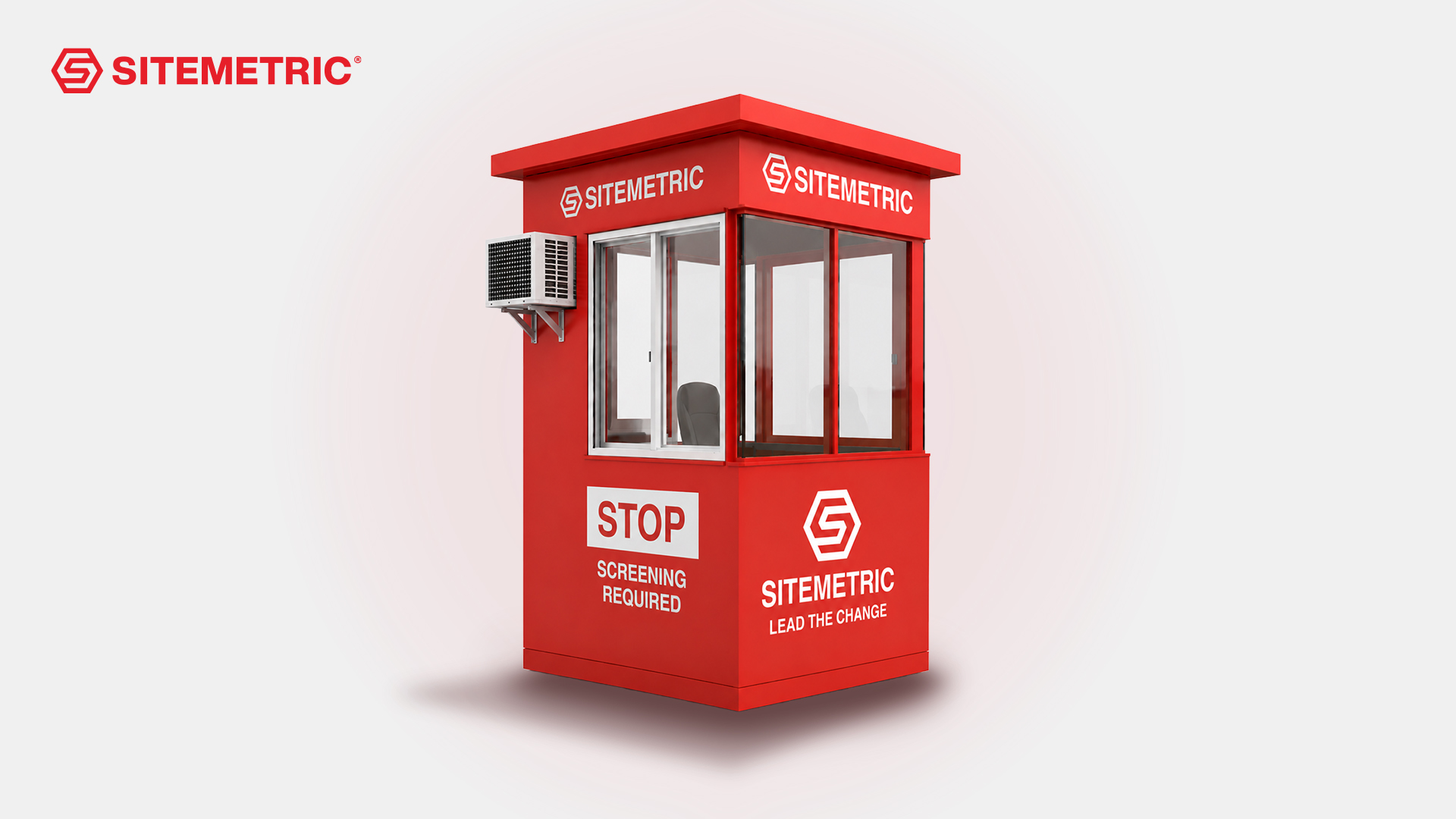
An access control booth is an enclosed structure at a jobsite entrance where personnel verify credentials, process visitors and deliveries, and manage entry. It gives the people running the gate a workspace with power, climate control, and sightlines.
An access control booth is an enclosed structure positioned at a jobsite entrance, staffed by personnel who verify credentials, document visitors and deliveries, badge workers, and handle anything the automated equipment cannot.
It goes by several names: guard booth, gatehouse, security booth, and access control booth. On construction sites the function is broader than the security-focused names suggest, since the person staffing the booth typically handles worker enrollment, delivery coordination, and visitor processing alongside site security.
The booth is not the access control mechanism. Turnstiles, gate arms, and readers control who passes. The booth is where a person works, and where exceptions get resolved.
Automated access control handles the routine case well: a credentialed worker arrives, scans, and enters. A staffed position at the gate can help with the predictable exceptions.
Visitors and deliveries. Someone who is not in the system, arriving for a legitimate reason, who has to be verified, documented, and directed.
Credential exceptions. A worker whose certification expired overnight, a subcontractor who arrived without being registered. Each of these stops the line if there is nowhere to resolve the issue.
Enrollment at the gate. New workers arriving unregistered on a project ramping up. Handling enrollment at the entrance rather than sending people away keeps crews productive.
Judgment. Whether a situation is a problem is a question access control equipment alone cannot answer.
Without a staffed position, these cases can queue behind one another at the turnstile, and the throughput the equipment was specified for stops being the throughput the gate delivers.
Place the booth where the exceptions happen, which is usually beside the worker entrance rather than at the vehicle gate, unless delivery traffic dominates.
Preserve sightlines. Personnel need to see the approach, the entry point, and ideally the queue. A booth positioned behind the turnstile sees people only after they are through.
Separate pedestrian and vehicle flow. A booth serving both needs to face both, and the two have very different timing.
Leave room for the queue. A booth at the property line with no space in front of it could put the morning line into the street.
Plan for relocation. The main entrance during excavation is rarely the main entrance during fit-out. A booth that cannot move becomes a booth in the wrong place.
Check the approach at 6am and at dusk, because sightlines and lighting change with the light and the queue.
A booth is a workplace, and the practical requirements are frequently underestimated.
Power runs lighting, climate control, the workstation, badge printing, and any equipment at the entry point. Ask any provider what the booth requires from the site and what it supplies itself, since that determines how early it can be deployed.
Climate control is a staffing requirement. Personnel working a full shift in an unconditioned enclosure in July or January is a retention and safety problem, and heating and cooling are what make a booth better than a tent, rather than worse.
Connectivity supports credential verification and badge issuance. As with other jobsite equipment, the question worth asking is what happens when the network drops, and whether verification continues locally.
Lighting matters at the booth and on the approach, since shift changes can happen in the dark for part of the year.
The activities that occur at a staffed entrance are broader than security.
Credential verification for workers, visitors, and delivery drivers. Visitor and delivery documentation, which is often the only record a project has of non-worker access. Worker enrollment and badge issuance for projects that badge onsite. Exception handling for expired credentials and unregistered arrivals. Coordination with site management, safety, and project teams. And a documented record of all of it.
Not every jobsite needs one, and whether your project needs one depends on a few conditions.
A booth generally makes sense if the project has a permanent staffed presence at the entrance, where visitor and delivery volume is high enough to need a dedicated position, where enrollment happens at the gate during ramp-up, where the climate makes an unconditioned position untenable for a full shift, or where the owner requires a controlled, documented entrance.
A project with low headcount, few visitors, and fully pre-cleared workers may need only equipment and a periodic presence.
Sitemetric deploys access control booths as part of an integrated entry point alongside turnstiles and gate arms, staffed by Sitemetric Access Control Officers rather than requiring the project to arrange staffing separately.
An enclosed structure at a jobsite entrance where personnel verify credentials, document visitors and deliveries, badge workers, and resolve exceptions. It is a workspace rather than a barrier. Turnstiles and gate arms control who passes; the booth is where the situations equipment cannot address get handled.
It depends how many exceptions the gate produces. Turnstiles handle credentialed workers arriving for their shifts. Visitors, deliveries, expired credentials, unreadable badges, and unregistered arrivals all must be addressed by a person, and that person needs somewhere to work. Without that, exceptions queue behind one another at the turnstile and throughput drops below what the equipment supports.
Mostly the scope of what happens inside. A guard booth implies security only. On Sitemetric construction projects, the same position typically handles worker enrollment, badging, delivery coordination, visitor documentation, and coordination with site teams alongside access control, which is why the broader term fits the function better.
Beside the worker entrance in most cases, with clear sightlines to the approach, the entry point, and the queue. Leave room in front so the morning line does not extend into the street, separate pedestrian and vehicle flow where possible, and choose a position you can relocate, because the main entrance during excavation is rarely the main entrance during fit-out.
Both, and climate control is a staffing requirement rather than a comfort feature. Personnel work full shifts inside, and an unconditioned enclosure in summer or winter can be a safety problem. Power also runs lighting, the workstation, badge printing, and equipment at the entry point.
Entrances move as the project changes phases from excavation through structure to fit-out, and a booth that cannot relocate ends up serving a gate nobody uses. Ask what relocation involves before the first placement.
On Sitemetric projects, Access Control Officers, who run the gate, verify credentials, document visitors and deliveries, badge workers, and coordinate with site management. Where staffing is arranged separately from the equipment, the person at the gate often cannot see the system they are enforcing.
Yes, if the project badges onsite. Sitemetric's Onsite ID Printing Station can deploy in a booth, so a worker arriving unregistered can be enrolled, verified, and badged at the entrance rather than being sent away and returning the next day.
Talk with our team about your jobsite needs and learn how Sitemetric can help your project succeed.

