Supercharge worksite productivity with Sitemetric AI.
Learn more
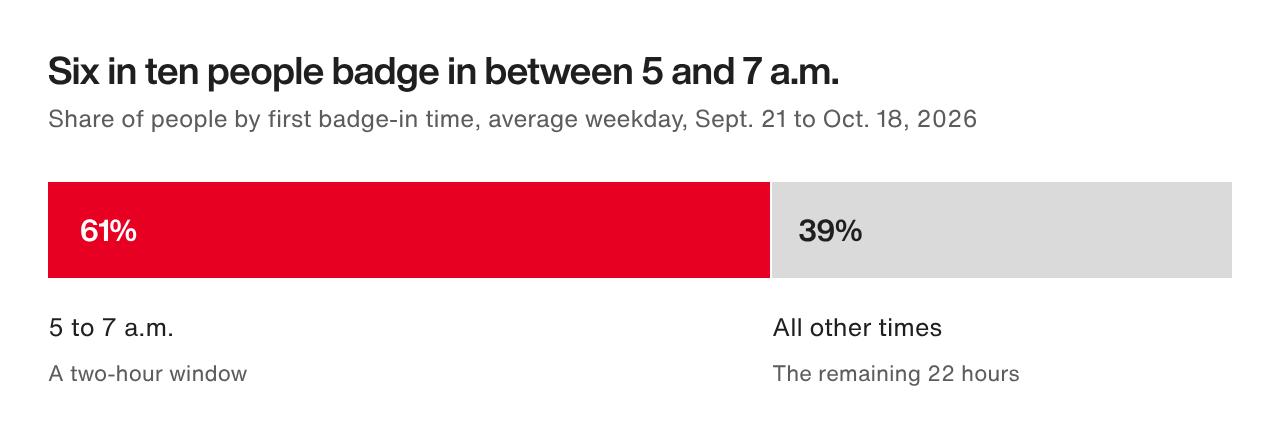
Six in ten people on the jobsites Sitemetric monitors, most of them data centers, badge in between 5 and 7 a.m. Here is what that peak does to safety at the gate, and what helps.

Construction site traffic management is hardest at shift start. On an average weekday from September 21 to October 18, 2026, six in ten people on the jobsites Sitemetric monitors badged in between 5 and 7 a.m. On a big job, that is thousands of people, vehicles and shuttles converging on a few gates in the dark.

At the busiest site Sitemetric saw, 1,089 workers came through the gates in 20 minutes on August 26, nearly one person every second. The top ten sites were all mission-critical projects, and each moved at least 575 workers in 20 minutes between July and October 2026. The afternoon is gentler: scan-outs peak at about half the morning rush and spread over several hours.
The morning rush puts several risks in one place at the same time:
A smoother morning keeps walkways clear and gives crews time for a solid pre-task plan.
Separate pedestrian and vehicle routes. Give people their own path from parking and shuttle stops to the gate, with lighting for the predawn hours.
Add scanning capacity or staff at the busiest gates during the peak. That keeps the line moving, so fewer people feel pressure to skip the scan.
Check cold-weather and dark-morning plans. In fall and winter, early arrivals happen in full darkness, so lighting and walkway conditions matter more.
Stagger start times by trade. Shifting trades by 15 to 30 minutes flattens the peak.
Stand at the gate at 5:30 a.m. one day this week. Is the line moving? Are walkways clear of traffic? Those two hours show where to start.
For more on how gates, turnstiles and badges fit together, see Sitemetric's guides to construction site access control, access control booths and construction turnstiles and badge readers. To see the turnstile Sitemetric deploys, visit our construction turnstiles page.
On the jobsites Sitemetric monitors, most of them data centers, about 61% of people badged in between 5 and 7 a.m. on an average weekday from September 21 to October 18, 2026. Departures are more spread out, with scan-outs peaking at about half the morning rush.
Common steps include staggering start times by trade by 15 to 30 minutes, separating pedestrian and vehicle routes, and adding scanning capacity or staff at the busiest gates during the peak.
For the full picture of what workforce data shows, see Data Center Construction Safety Statistics: What 4.5 Million Worker-Days Show.

Talk with our team about your jobsite needs and learn how Sitemetric can help your project succeed.