
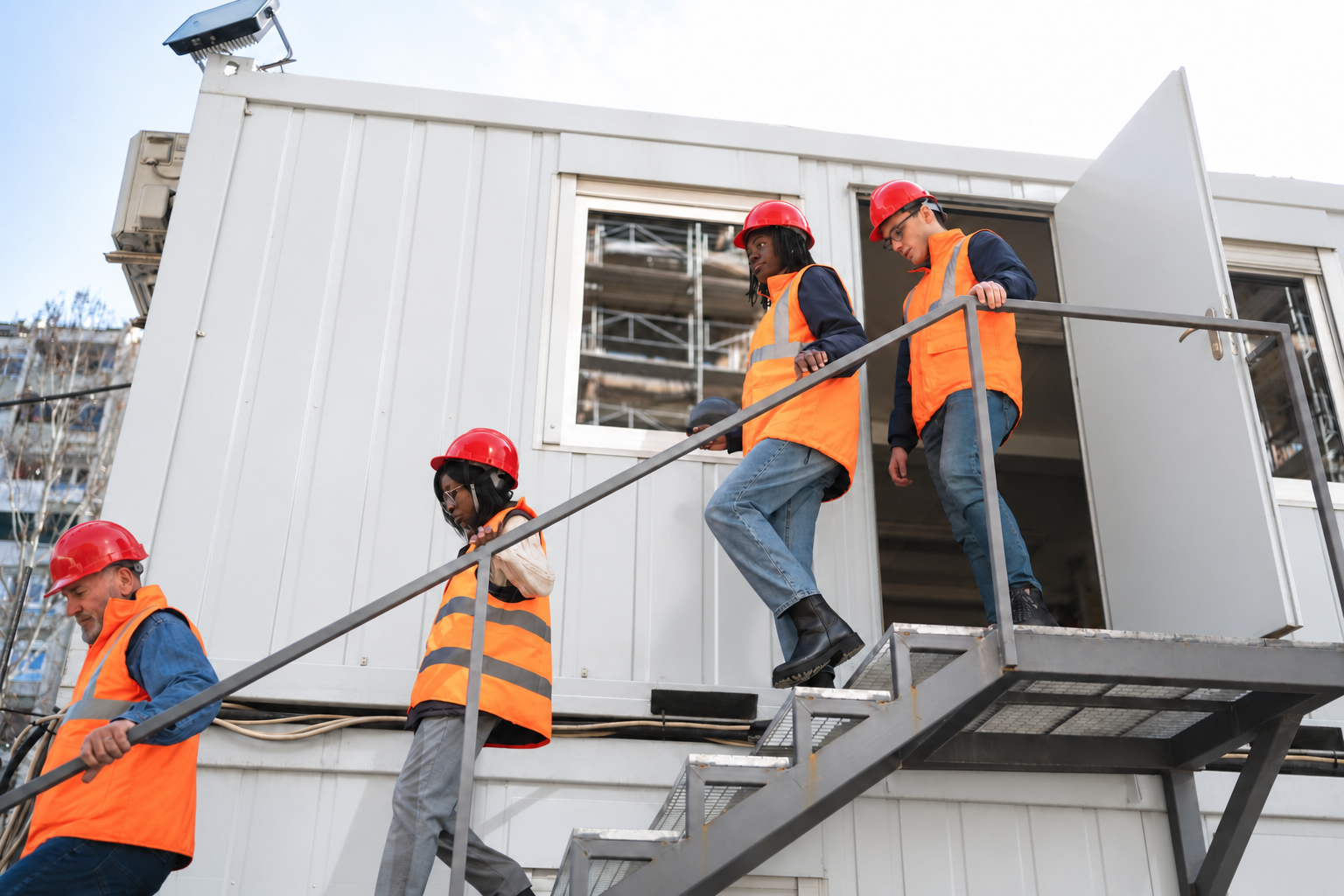
Emergency mustering is the process of accounting for everyone on a jobsite after an evacuation. Workers move to designated muster points and are checked against a roster of who was onsite, producing a count of who is accounted for and, critically, who is not.
Emergency mustering is the procedure for evacuating a jobsite and accounting for everyone who was on it. After an alarm, workers move to predetermined muster points, and someone checks a list of who has arrived against a list of who should be there.
The purpose is to answer a single question: is anyone still inside? Everything about a muster procedure exists to answer that question quickly and correctly.
Construction makes this challenge harder than most environments. The population changes daily, workers are associated with dozens of different employers, the site layout changes throughout the project, and the record of who is present is often nothing more than a clipboard.
1. The roster exists before the alarm. Mustering cannot produce an accurate count without knowing who entered the jobsite and has not left. For this reason, mustering is really a function of access control.
2. Notification reaches the workforce. An alarm, a mass notification, or both. On a large or noisy site, an audible alarm alone does not reliably reach everyone.
3. Workers move to muster points. Locations are designated in advance, communicated at orientation, and marked onsite. Large projects need several, positioned so no one has an unreasonable distance to travel.
4. Arrivals are recorded at each point. Badge scan, manual check, or both. The method determines how fast the count converges.
5. Status reconciles across all points. A worker expected to muster at point A who instead musters at point B must clear from the expected list at point A, or the count shows a false unaccounted.
6. The gap is identified and searched. The unaccounted list is what emergency responders act on, and the speed with which it becomes accurate is the value of the system.
7. The event is documented. Timing, counts, and outcome, which is what an investigation or an insurer reviews later.
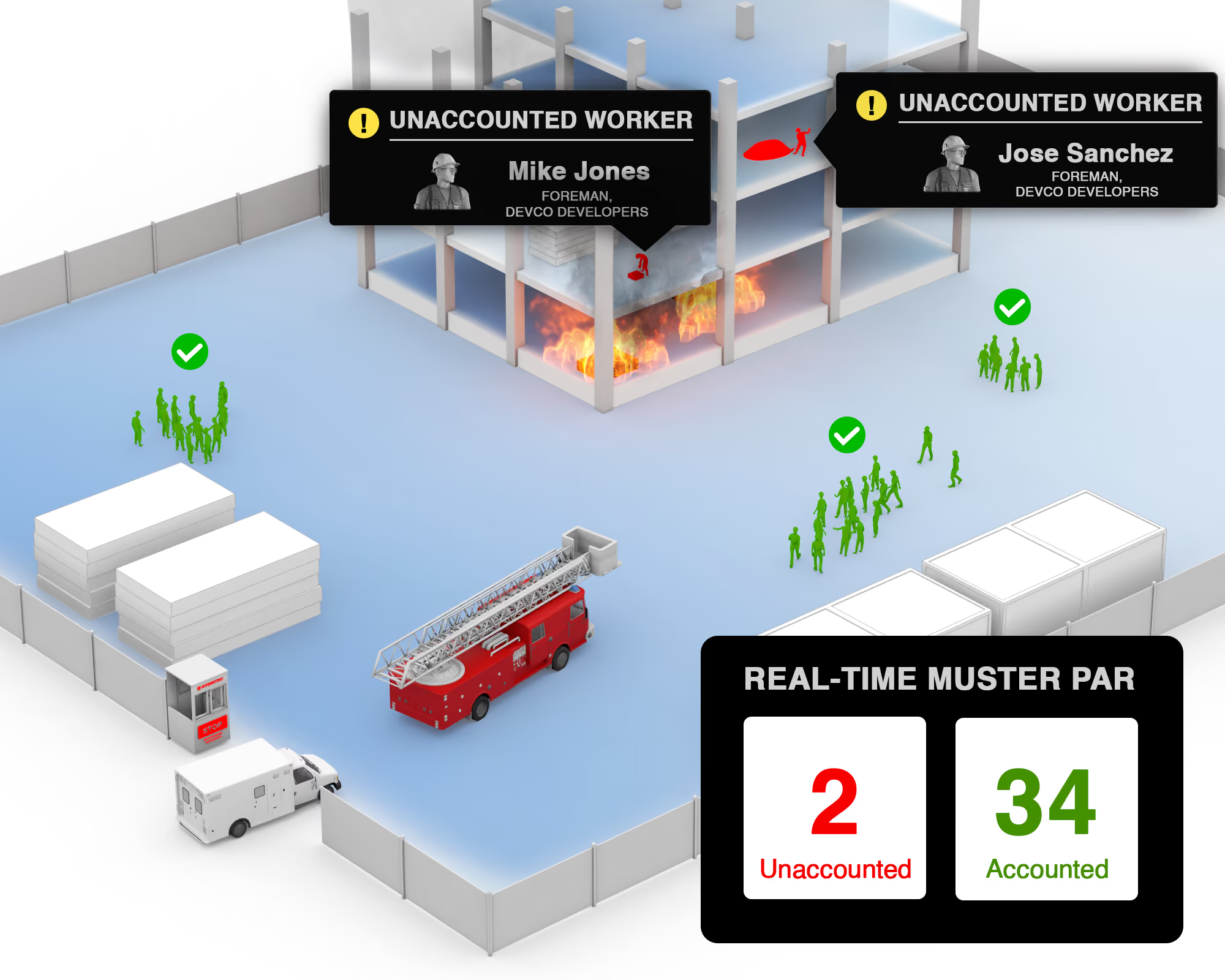
Paper works… until the conditions in which you need emergency mustering actually occur. Then paper can fall short, for a number of reasons:
The roster is often in the trailer. The document listing who is onsite is frequently stored in the building the crew just evacuated.
Sign-in sheets record arrivals, not departures. A sheet with 340 names does not say how many of those people left at lunch, which means the number of unaccounted people is inflated from the start.
Subcontractors keep their own lists. On a project with thirty employers, reconciling thirty separate rosters at a muster point takes longer than the emergency allows.
Handwriting and legibility. Names collected in a hurry at 6am are read under pressure at 2pm.
There is no live count. The most useful number during an evacuation is how many people are currently unaccounted for, and a paper process cannot produce it until every list has been walked.
Any jobsite large enough to need more than one muster point has a reconciliation problem, and it is the failure mode most procedures overlook.
A worker leaves the north end of the site and musters at the south point because that is the direction they were facing. If the two points keep separate lists, the north list shows that worker missing while the south list shows an unexpected arrival. Multiply across a few hundred workers and the unaccounted list becomes noise.
Solving it requires status to sync across every muster point in real time, so a check-in anywhere clears the worker everywhere. Without that, someone reconciles lists by radio while responders wait.
An evacuation produces a record whether or not anyone plans for it, and the quality of that record matters afterward.
Useful documentation includes the time the evacuation began, the number of people onsite at that moment, the time each worker was accounted for, the identity of anyone unaccounted and for how long, the time the all-clear was given, and total duration. Automated capture matters here because it's very unlikely anybody is writing timestamps down during an actual emergency.
This record supports incident investigation, insurer review, owner reporting, and drill assessment. It is also the evidence that a procedure worked, which is worth having before someone asks.
Mustering on the Sitemetric platform runs off the same access record as everything else, so the roster is the live headcount rather than a separate list. Badges identify workers at muster points, and mass notifications can reach the workforce during the event.
A designated location where workers gather after an evacuation so they can be accounted for. Muster points are chosen in advance, communicated during orientation, and marked onsite. Large projects need several, positioned so nobody has an unreasonable distance to travel from where they work.
By checking who arrives at muster points against who was onsite when the alarm sounded. The accuracy of that comparison depends entirely on the roster being correct, which is why mustering works far better when it draws on access control records than when it relies on sign-in sheets.
Several reasons. The sheet is often inside the trailer being evacuated. It records arrivals but not departures, so it overstates who is onsite. Subcontractors keep separate lists that have to be reconciled under pressure. And it cannot produce a live count of who is still unaccounted for, which is the number that matters most.
The badge creates the record of who entered and has not left, so it produces the roster automatically. At the muster point the same credential identifies the worker, and their status updates in real time. No separate list, no reconciliation between the gate record and the muster record.
Status has to sync across all of them, or the count is wrong. A worker who leaves the north end and musters at the south point will show as missing at one point and unexpected at the other. On the Sitemetric platform a check-in at any point clears the worker everywhere in real time.
It depends on site size, the number of muster points, and how workers are checked in, so any specific figure is worth testing during a drill rather than accepting from a vendor. What determines the answer more than anything is whether the starting roster is accurate, because an inflated count means searching for people who left hours ago.
Start time, headcount at that moment, when each worker was accounted for, who was unaccounted and for how long, the all-clear time, and total duration. Automated capture matters, because it is very unlikely anyone will record timestamps during an actual emergency. This record is what an investigation, an insurer, or an owner reviews afterward.
It should be, and a system that only works during a real event is not a system anyone should rely on. Running the same process during drills tests the procedure, familiarizes the workforce with muster points, and produces documentation that the program works.
Talk with our team about your jobsite needs and learn how Sitemetric can help your project succeed.

