
.jpg)
AI PPE detection uses cameras with onboard computer vision to identify whether workers are wearing required protective equipment such as hard hats, high-visibility vests, and eye protection. When the system detects a worker without required PPE, it flags the event for review rather than waiting for a supervisor to notice it in person.
AI PPE detection is the use of computer vision to identify personal protective equipment in a camera frame and flag workers who appear to be missing it. The camera compares what it sees against the equipment the project requires, and produces an event when the two do not match.
The practice goes by several names: PPE compliance monitoring, hard hat detection, safety compliance cameras, and AI safety monitoring. They describe the same underlying capability applied to different equipment types.
PPE detection sits inside a broader monitoring program rather than standing alone. The same camera platform that identifies missing hard hats generally also detects falls, fire and smoke, restricted zone entry, and after-hours activity. Projects rarely deploy cameras for PPE alone.
1. Cameras cover the areas where PPE matters. Placement follows entry points, active work zones, and areas with specific equipment requirements. A camera aimed at a parking lot produces little useful PPE data.
2. The model identifies people and equipment separately. Computer vision locates a person in frame, then determines whether the required equipment appears in the expected position relative to that person. Hard hats, high-visibility vests, and eye protection are the common detection classes.
3. The system produces an event, not a judgment. A detection records that a worker appeared without an item, at a time and location.
4. Review determines what happens next. Some events route to a supervisor's app. Some route to a monitoring center. The routing decision, and who is accountable for acting, is what turns detection into compliance.
5. Events accumulate into a record. Over weeks, PPE events become a dataset showing which areas, times, and conditions produce the most exposure. That record supports safety programs and, increasingly, what owners ask to see.
Reliably detected:
Not reliably detected:
The practical consequence is that PPE detection alone is an exception-surfacing tool rather than an enforcement mechanism. It narrows thousands of hours of footage down to the moments worth a human look.
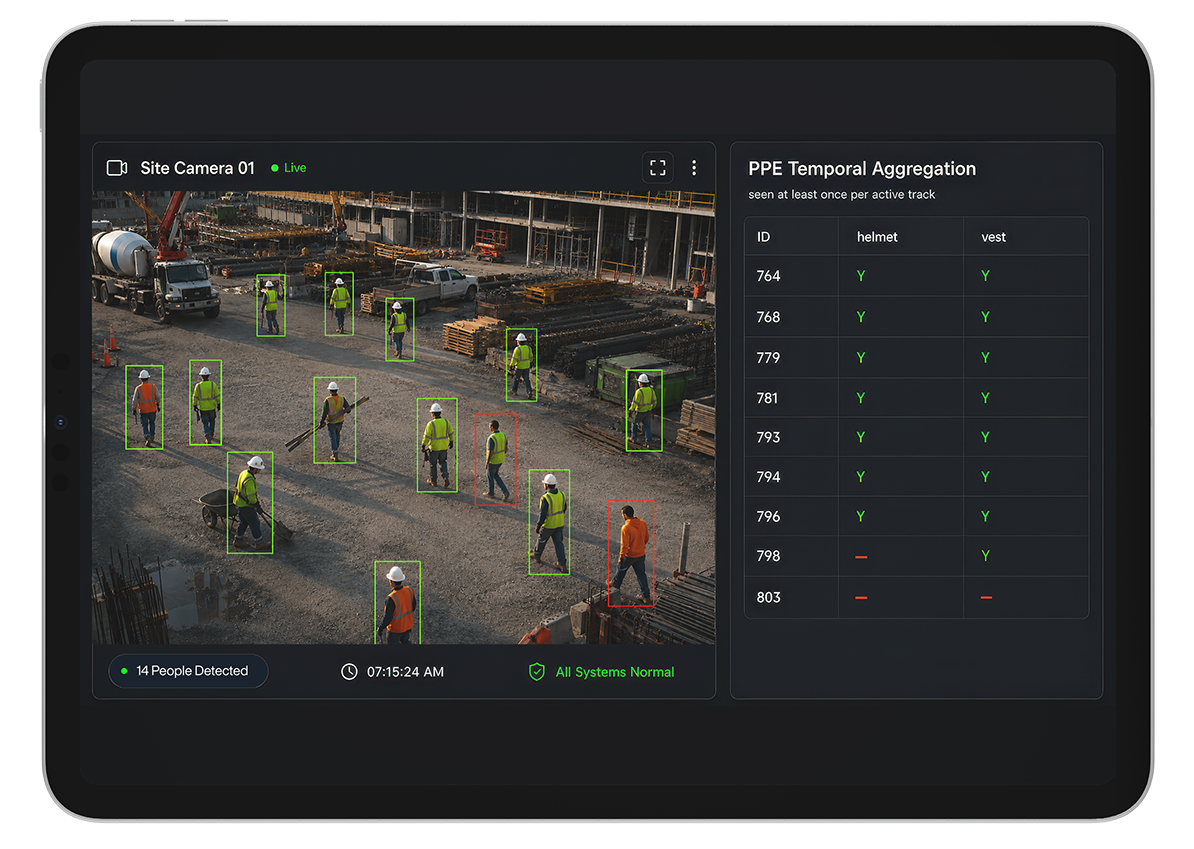
A model trained on clean indoor footage performs poorly on an active jobsite, and the reasons are specific.
Dust and particulate degrade image clarity in exactly the conditions where PPE matters most.
Glare and darkness shift throughout the day. A camera facing east produces different results at 7am than at 2pm, and night work adds another regime entirely.
High-visibility on high-visibility. When a worker in a hi-vis vest stands against hi-vis barriers, cones, and equipment, the color signal a general model relies on becomes difficult to distinguish.
Density and occlusion. Crews work in groups. A worker fully visible in one frame could be half-hidden in the next.
Constant change. The scene a camera learned last month is now a different structure with different sightlines.
This is why a system's training data matters more than its specification sheet. Ask what conditions the model was trained on, and whether the provider can describe how it handles the cases above.
False alarms kill monitoring programs. A system that flags correctly ninety percent of the time still produces enough noise that teams stop looking, and once they stop looking the real events are missed too.
Three things can reduce the problem. Classification rather than motion means the system reports a person without a hard hat rather than reporting that something moved. Human review before escalation means an operator filters events before anyone onsite is contacted. Tuning to the project means detection rules reflect this jobsite's requirements rather than a generic template.
Ask any provider what proportion of alerts reach the customer, and what happens to the rest.
PPE detection produces images of identifiable people, and how a program handles that can determine whether crews accept it.
Programs that work tend to share a few characteristics. The purpose is stated plainly to the workforce rather than discovered. Detection is framed around conditions and areas rather than individuals. Access to footage is limited and documented. And the program is introduced through the safety function rather than as surveillance.
Programs that generate resistance tend to invert those. Worth settling the framing with your safety leadership before the first camera goes up, because the reaction to a system introduced badly is difficult to reverse.
Sitemetric AI Cameras classify specific event types rather than reporting generic motion, and PPE detection is one of several detection types running on the same platform. Alerts route to JSOC (Joint Security & Operations Center), Sitemetric's 24/7 U.S.-based monitoring center, where an operator reviews the event before anyone onsite is contacted.
Hard hats, high-visibility vests, and eye protection are the standard detection classes, verified per worker rather than as a general scene assessment. What a camera cannot reliably determine is whether equipment is worn correctly as opposed to carried or hung, which is why detections are treated as events for review rather than as confirmed violations.
Accuracy depends far more on training conditions than on camera specifications. Dust, glare, darkness, and high-visibility clothing against high-visibility backgrounds are the conditions where general-purpose models degrade, and they are also normal conditions on a jobsite. Ask a provider what their models were trained on rather than asking for an accuracy percentage.
No, and a program built on that assumption tends to fail. Detection narrows continuous footage down to the moments worth a human look. It does not assess context, judge whether a requirement applies in a given area, or intervene. It gives a safety team more coverage than walking the site allows, not a substitute for the team.
Through classification and review. Sitemetric cameras identify specific event types rather than reporting any movement, and a JSOC operator assesses flagged events before anyone onsite is contacted. This matters because a system that produces frequent false alerts trains everyone to ignore it, including on the day the alert is real.
Programs that work tend to state the purpose to the workforce plainly, frame detection around conditions and areas rather than individuals, limit and document access to footage, and are introduced through the safety function. Settle the framing with your safety leadership before deployment.
It should, and this is worth testing rather than assuming. Night work, dust, rain, and glare are normal jobsite conditions, not edge cases. Sitemetric models are trained on those conditions specifically, and thermal camera configurations are available for positions where visible-light detection is not sufficient.
On the Sitemetric platform, camera events and badge reads resolve to the same worker ID, so a PPE event sits in the same record as that worker's access history. When detection and access data live in separate systems, reconciling them during an incident review means matching timestamps by hand across two exports.
Timestamped events with retained footage and searchable history, which supports safety program review, incident investigation, and the compliance documentation owners increasingly request. Ask any provider to show an actual export rather than describing one, since the format determines whether it is usable in a claim or an audit.
Talk with our team about your jobsite needs and learn how Sitemetric can help your project succeed.

