Supercharge worksite productivity with Sitemetric AI.
Learn more

Construction Fatigue Management Starts With Knowing Where Hours Stack Up

Fatigue builds across a shift, a week and days in a row without a break. Workforce data shows where those hours concentrate, and the list is shorter than you might expect.

Construction crew working under site lights at night

Construction fatigue management works best when it starts with data on where hours stack up. Fatigue is not just one long day. It builds from total hours across a shift, a week and days in a row without a break, and on the jobsites Sitemetric monitors, most of the long days come from a small share of crews.

What is fatigue management in construction?

Construction fatigue management is a set of site practices that limit how long people work before they get rest, usually covering daily hours, weekly hours and days in a row. Many plans set separate limits for day and night shifts. The goal is to spot people approaching those limits before their next shift.

How common are long days in construction?

Long days are common on the jobsites Sitemetric monitors, and the data shows all three kinds of fatigue risk:

  • Long shifts. About 6% of worker-days in September ran past 12 hours on site, around 266,000 long days.
  • Long weeks. In the week of September 14, about 20,000 people (8% of the workforce) were on site 60+ hours, and more than 5,000 were on site over 70.
  • Days in a row. About 26% of people were on site six or more days a week, and about 9,000 were there all seven days.

These figures measure time on site, from badge-in to badge-out. That is not the same as hours worked, but it is the earliest warning most safety teams have.

Time on site is not the same as hours worked, but it is the best early warning you have.

Long hours are concentrated in 5% of crews

Long days are not spread evenly across a jobsite. Just 5% of crews accounted for 86% of the 12-hour-plus days, even though those crews work about half of all worker-days. That makes fatigue something a safety team can manage, because it comes down to knowing which crews to focus on.
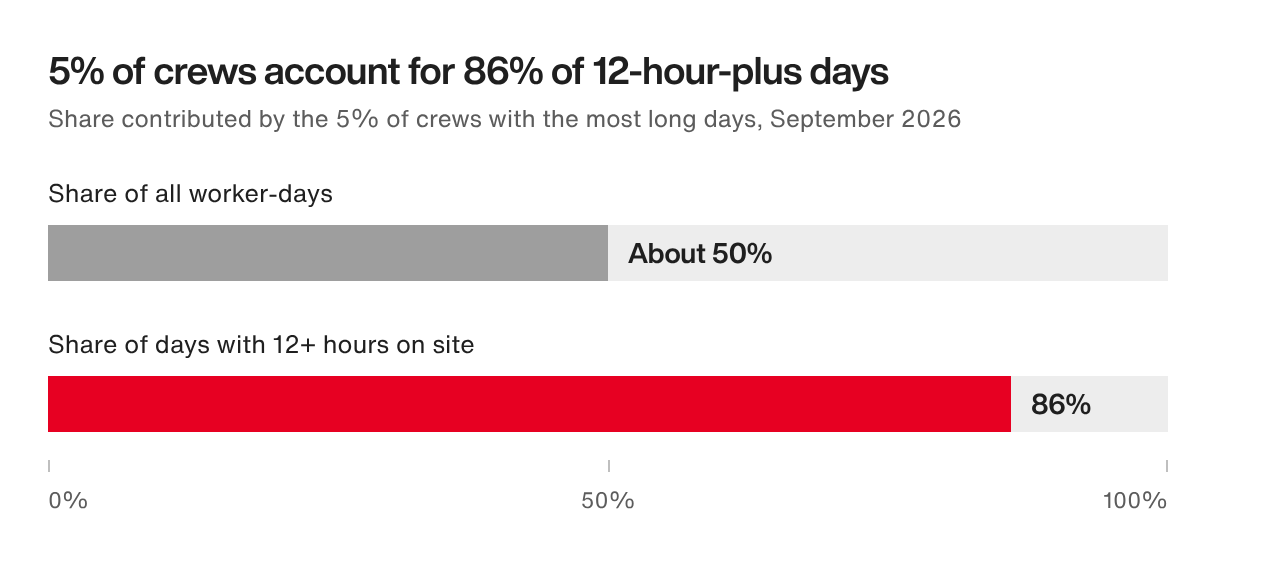
The 5% of crews with the most long days work about half of all worker-days but produce 86% of 12-hour-plus days
A crew is one company at one site. Hours are time on site. Source: Sitemetric badge data, September 2026.

What to watch on your jobsite

  • The crews with the most long days. Work with their foremen on relief and rotation.
  • Anyone approaching the daily, weekly or days-in-a-row limits in your fatigue management plan.
  • Night crews, who may benefit from extra support with fewer people around.
  • Upcoming shifts for people already near their limit, so you can act before the shift, not after.

How Sitemetric's Fatigue Report flags long hours before the next shift

  • Fatigue Report. Set your fatigue management limits once, with separate day and night limits for daily hours, weekly hours and days in a row. Sitemetric flags who is getting close each morning, before the next shift.
  • Ask Sitemetric AI. Type "Which companies had workers over 12 hours yesterday?" and get the answer.
  • If something happens, you will know right away when that person showed up and how many days straight they had worked. No sign-in sheets to dig through.

See how these fit into Sitemetric's construction safety platform. For tracking hours across a large workforce, see the guide to construction workforce management.

Construction fatigue management FAQ

Is time on site the same as hours worked?

No. Time on site runs from badge-in to badge-out, so it includes breaks and time spent getting to and from the work area. It is still a useful early warning for fatigue because it shows how long people are at the jobsite.

What limits should a construction fatigue management plan include?

Most plans cover daily hours, weekly hours and days in a row, often with separate limits for day and night shifts. The right numbers depend on the site, the trades and company policy.

For the full picture of what workforce data shows, see Data Center Construction Safety Statistics: What 4.5 Million Worker-Days Show.

Pete Johnson
National Director of EHS

Pete Johnson is National Director of EHS at Sitemetric, where he oversees the protection and performance of a 2,000+ person workforce in hyperscale data center construction. He leads the development and execution of enterprise-level EHS strategies for mission-critical infrastructure.

← All insights

The job moves fast.
Your tech should too.

Talk with our team about your jobsite needs and learn how Sitemetric can help your project succeed.